

- What Is the Difference Between VRV and VRF?
- What Is a VRV Air Conditioning System?
- What Is a VRF Air Conditioning System?
- How Do VRV and VRF Systems Work?
- Key Components and Operating Principles
- VRV vs VRF: Key Differences Compared
- Benefits of VRV and VRF Air Conditioning Systems
- Energy Efficiency and Individual Temperature Control
- VRV vs VRF Installation Cost and Maintenance
- Which System Is Best for Homes and Commercial Buildings?
- How to Choose the Right HVAC System
- Conclusion
- Frequently Asked Questions
Choosing the right air conditioning system is an important decision for anyone constructing a commercial building, renovating an office, designing a hotel, or planning a modern home. Traditional split air conditioners work well for individual rooms, but larger buildings often need a more flexible cooling solution that can maintain different temperatures in multiple spaces. This is where VRV and VRF air conditioning systems become useful. They are designed to distribute refrigerant to multiple indoor units and adjust their operation according to the cooling or heating requirements of different zones. If you have been researching commercial HVAC systems, you have probably come across both terms and wondered whether they refer to different technologies.
Here is the simple answer: VRV and VRF refer to essentially the same type of air conditioning technology. VRV stands for Variable Refrigerant Volume, while VRF stands for Variable Refrigerant Flow. According to Daikin, the company introduced VRV technology in 1982 and owns the VRV trademark, while VRF is the widely used industry term for the same general technology.
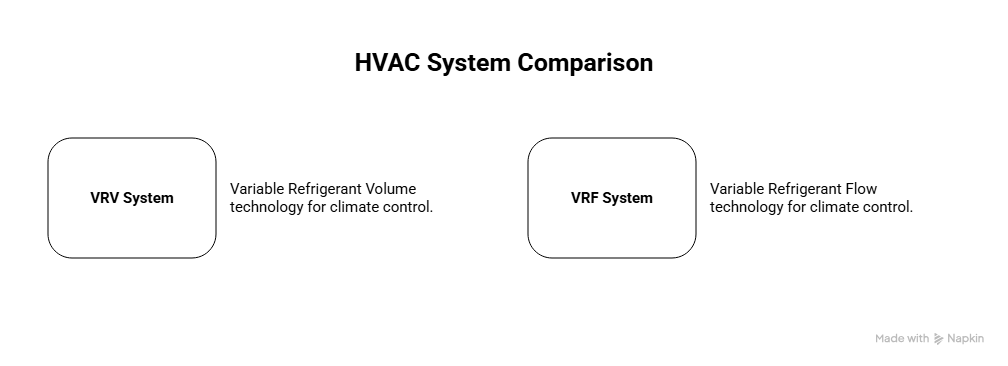
The practical differences you should investigate are therefore not simply the abbreviations, but the manufacturer, model specifications, installation quality, control features, energy performance, and service support. In this guide, you will learn how both systems work, what they cost to install and maintain, and how to select the right solution for your building.
What Is the Difference Between VRV and VRF?
The most important thing to understand about the VRV vs VRF difference is that the names do not describe two fundamentally different HVAC technologies. Both systems use refrigerant to transfer heat between indoor units and an outdoor unit or connected outdoor-unit assembly. Their compressors and control systems can adjust capacity according to the cooling or heating demand of the spaces being served. This makes them suitable for buildings where different rooms need different temperatures at different times. Instead of operating every room at full capacity continuously, the system can modulate its output to match changing requirements, subject to the equipment’s operating limits.
The terminology mainly reflects branding and industry usage. Daikin uses the name VRV for its trademarked product technology, while other manufacturers commonly use VRF to describe their variable-refrigerant-flow systems. That distinction matters when you are comparing specific products, because two systems using the same general principle can still differ significantly in their design, controls, available capacities, supported indoor units, warranties, and service requirements. For example, one manufacturer’s equipment may offer particular heat-recovery features or control integrations that another model does not provide. The smartest comparison is to evaluate complete system specifications instead of assuming that VRV is always superior to VRF, or that VRF must be cheaper.
What Is a VRV Air Conditioning System?
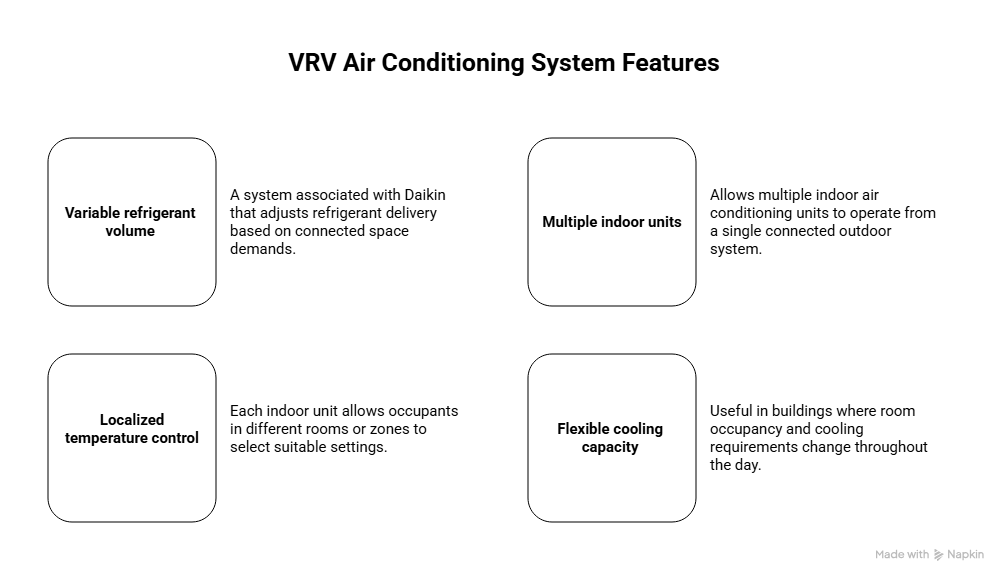
A VRV air conditioning system is a variable-refrigerant-volume system associated with Daikin. It allows multiple indoor air conditioning units to operate from a connected outdoor system, with refrigerant delivery adjusted according to the demands of the connected spaces. Each indoor unit can provide localized temperature control, allowing occupants in different rooms or zones to select suitable settings within the system’s operating limits. This arrangement can be useful in buildings where room occupancy and cooling requirements change throughout the day. An office meeting room, for instance, may need substantial cooling during a presentation but very little when nobody is using it.
VRV systems are available in different configurations, including options designed for commercial buildings, residential applications, and projects with more specialized requirements. Depending on the selected model, the indoor units may be wall-mounted, ceiling-mounted, cassette-style, or concealed ducted units. Certain systems also offer heat-recovery capabilities that can support simultaneous cooling and heating in different zones. These features make VRV a flexible option for hotels, offices, retail spaces, and other buildings that require more than one indoor comfort zone. However, the exact capabilities depend on the specific product series, so always confirm the manufacturer’s documentation before choosing a system.
What Is a VRF Air Conditioning System?
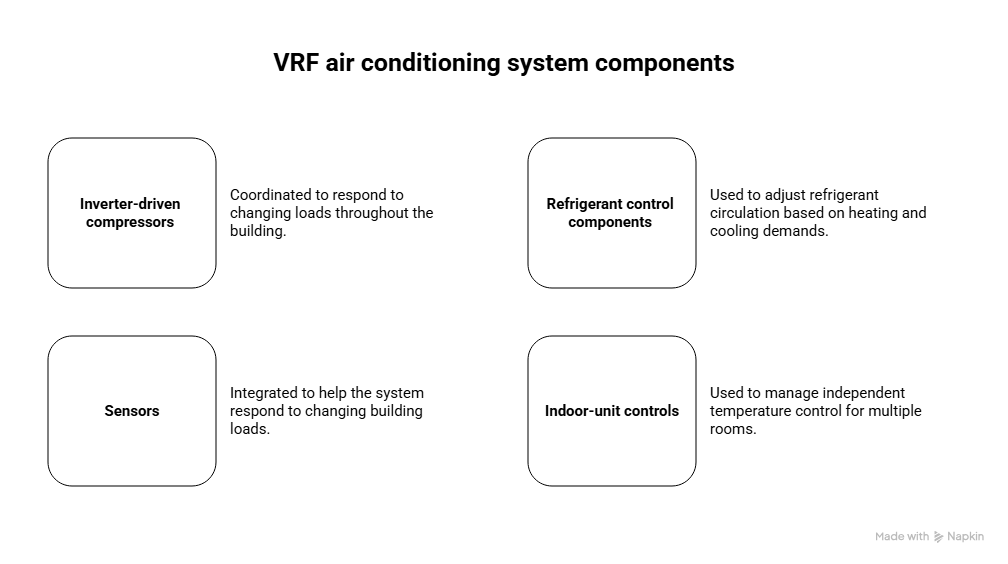
A VRF air conditioning system uses variable refrigerant flow technology to adjust refrigerant circulation according to the heating and cooling demands of connected indoor units. It is commonly used in commercial HVAC applications where multiple rooms need independent temperature control and where installing extensive ductwork may not be practical. By coordinating inverter-driven compressors, refrigerant control components, sensors, and indoor-unit controls, the system can respond to changing loads throughout the building. This helps maintain comfort while avoiding some of the unnecessary energy consumption associated with poorly matched or constantly full-output operation.
VRF systems are offered by multiple HVAC manufacturers, and the available features vary from one product range to another. Some models focus on cooling and heating through a heat-pump arrangement, while others support heat recovery for buildings that need simultaneous heating and cooling in different zones. Installation flexibility is another important advantage, as compatible systems can support different indoor-unit styles and building layouts within their specified limits. Still, VRF is not automatically the best choice for every property. A small home with two rooms may be served more economically by conventional split AC units, whereas a multi-floor office building may benefit from a properly designed VRF systems
How Do VRV and VRF Systems Work?
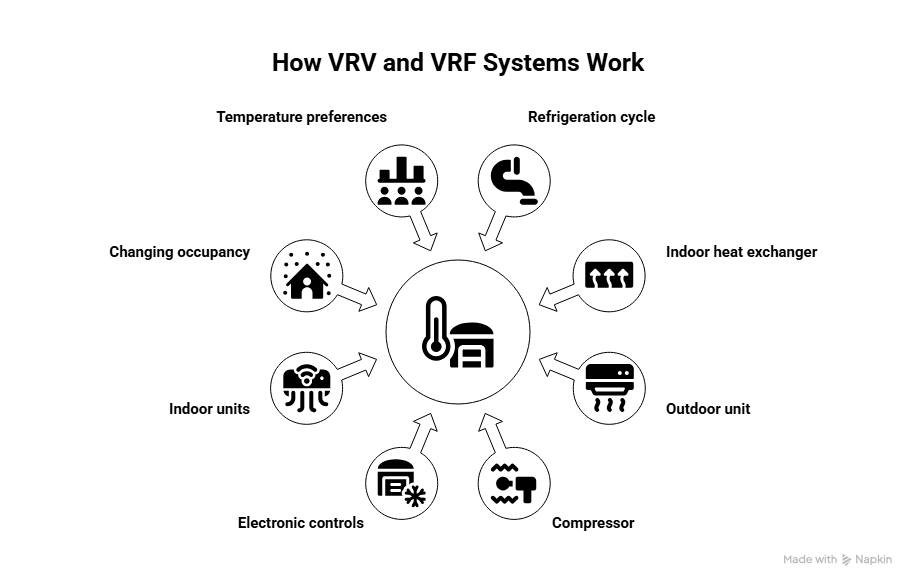
Both VRV and VRF systems use the refrigeration cycle to move heat from one place to another. During cooling, the indoor heat exchanger absorbs heat from the room, and the refrigerant carries that heat to the outdoor unit, where it is released. The compressor circulates the refrigerant, while electronic controls adjust system operation according to demand. When several indoor units are connected, each zone can request a different amount of cooling, and the system responds within its design capacity. This makes the technology particularly useful for buildings with changing occupancy levels and different temperature preferences.
The main difference between these systems and a collection of conventional fixed-speed air conditioners is their ability to coordinate capacity across multiple zones. Rather than treating every room as a completely separate cooling installation, a VRV or VRF arrangement can use a shared outdoor system to serve several indoor units. That can reduce the number of separate outdoor units required, depending on the design, and can provide more centralized control. However, these systems require careful engineering because refrigerant piping lengths, elevation differences, total connected capacity, and operating conditions must comply with the manufacturer’s specifications.
Key Components and Operating Principles
Although product designs vary, VRV and VRF installations generally include several essential components that work together to provide reliable cooling.
- Outdoor unit: Houses the compressor and heat-exchange equipment responsible for transferring heat between the refrigerant circuit and the external environment.
- Indoor units: Deliver cooling or heating to individual rooms or zones, depending on the system configuration.
- Refrigerant piping: Connects the outdoor and indoor equipment and carries refrigerant through the system.
- Electronic expansion and control components: Help regulate refrigerant delivery according to the operating requirements.
- Controllers and sensors: Allow users to adjust temperatures, establish operating schedules, and coordinate system operation.
- Optional centralized controls: Can help facility managers monitor and manage multiple indoor units across larger buildings.
The way these components interact determines how effectively the system responds to real-world demand. For example, an office may have ten rooms, but only six may be occupied during a particular period. A suitably configured system can adjust its output to match the demand from the operating zones rather than automatically supplying maximum capacity everywhere. Some models also support centralized monitoring and integration with building-management systems. These features can make operation more convenient, but their availability depends on the equipment selected and the control architecture specified during design.
VRV vs VRF: Key Differences Compared
If you are comparing VRV and VRF for a building project, remember that the terminology is not the most important factor. VRV is Daikin’s trademarked term, whereas VRF is the general industry term used by multiple manufacturers for variable-refrigerant-flow systems. Both can offer zoning, variable-capacity operation, and a selection of indoor-unit configurations. The meaningful differences appear when you compare particular products, installation requirements, operating capabilities, warranty conditions, and the availability of qualified service technicians. A detailed comparison should therefore focus on the actual specifications rather than the abbreviation printed in a brochure.
| Comparison factor | VRV | VRF |
|---|---|---|
| Full form | Variable Refrigerant Volume | Variable Refrigerant Flow |
| Terminology | Trademark associated with Daikin | General industry terminology |
| Basic technology | Variable-refrigerant HVAC | Variable-refrigerant HVAC |
| Individual zone control | Available, depending on system design | Available, depending on system design |
| Energy efficiency | Depends on model, design, and operation | Depends on model, design, and operation |
| Indoor-unit options | Vary by product range | Vary by manufacturer and product range |
| Installation requirements | Manufacturer-specific design limits | Manufacturer-specific design limits |
| Maintenance | Requires appropriate expertise and compatible parts | Requires appropriate expertise and compatible parts |
| Best choice | Based on the suitability of the specific Daikin system | Based on the suitability of the selected manufacturer’s system |
The comparison makes one point clear: there is no universal technical winner simply because one system is called VRV and another is called VRF. A well-designed VRF installation from one manufacturer may be a better fit for a particular building than a VRV installation, while a suitable Daikin VRV model may be the stronger option for another project. Compare the applicable energy-performance figures, operating range, sound levels, controls, service network, and installed cost. You should also check that the contractor has experience with the exact equipment being proposed. The best HVAC solution is the one that meets the building’s requirements reliably and economically.
Benefits of VRV and VRF Air Conditioning Systems
VRV and VRF systems offer several advantages for properties that require flexible, multi-zone cooling. Their variable-capacity operation can help match cooling output to demand, while multiple indoor units allow occupants to control different spaces independently. A single coordinated system may also reduce the need for numerous individual outdoor units, depending on the building layout and equipment selection. These characteristics make the technology attractive for commercial offices, hotels, retail spaces, healthcare buildings, and larger residential properties. Nevertheless, the actual benefits depend on thoughtful system design, correct installation, and appropriate operation.
Another advantage is design flexibility. Depending on the model, indoor units can be installed in different configurations to suit the appearance and function of a space. A hotel might use concealed ducted units in selected rooms, while a retail environment might use ceiling cassettes to distribute air across an open floor. Centralized controls can make it easier for building managers to establish schedules and oversee multiple zones. Some heat-recovery systems can also transfer heat between areas that require cooling and those that require heating, helping make use of energy that would otherwise be rejected outdoors.
Energy Efficiency and Individual Temperature Control
Energy efficiency is one of the main reasons building owners consider VRV and VRF systems. Conventional cooling equipment that operates inefficiently or is poorly matched to the cooling load can waste electricity, particularly when demand changes throughout the day. Variable-capacity compressors can adjust their output rather than always operating at maximum capacity, helping the system respond to changing room conditions. Individual zone control can also reduce unnecessary cooling in spaces that are not occupied, provided the system and controls are configured appropriately. However, savings are not guaranteed simply by installing VRF technology; they depend on climate, building insulation, equipment selection, operating schedules, and maintenance.
Consider a commercial office where meeting rooms, private offices, and common areas have different occupancy patterns. If a meeting room remains empty for several hours, there may be little reason to cool it to the same extent as an occupied workspace. A multi-zone system can provide greater flexibility in managing those differences than a poorly controlled system that cools every area uniformly. For the best results, combine suitable equipment with sensible temperature settings, effective shading, well-maintained filters, and professional commissioning. Ask suppliers to provide comparable performance data for the actual models under consideration, rather than relying on broad claims about a particular technology.
VRV vs VRF Installation Cost and Maintenance
Installation cost is an important consideration when comparing HVAC systems, especially for larger properties where equipment, piping, electrical work, and controls represent a substantial investment. There is no reliable universal price difference between VRV and VRF because the names refer to the same general technology rather than two distinct equipment categories. The cost depends on the manufacturer, required cooling capacity, number of indoor units, pipe routing, building height, installation complexity, and the control features selected. Local labor rates, material prices, taxes, and project conditions also affect the final quotation.
The initial equipment price is only one part of the total cost. A complete project estimate should account for design, installation, commissioning, electrical provisions, drainage, controls, and future servicing. For a large building, request an itemized quotation that clearly explains what is included and what may incur additional charges. Compare proposals using the same cooling requirements and comparable equipment specifications so you are not evaluating unlike systems. It is also sensible to ask about expected maintenance requirements, warranty coverage, spare-parts availability, and the contractor’s experience with the proposed product range.
Installation Cost Comparison
The following table explains the main cost factors without presenting unsupported fixed prices.
| Cost factor | What affects the cost |
|---|---|
| Outdoor equipment | Capacity, model, configuration, and efficiency |
| Indoor units | Quantity, type, and required capacity |
| Refrigerant piping | Total length, pipe sizes, insulation, and routing complexity |
| Electrical work | Supply requirements, protection, cabling, and control wiring |
| Installation labor | Site accessibility, building height, and project duration |
| Controls | Individual controllers, centralized controls, and building integration |
| Commissioning | Testing, configuration, and performance verification |
| Ongoing maintenance | Service frequency, spare parts, and equipment accessibility |
To compare long-term value, consider the total cost of ownership rather than only the purchase price. A more expensive system may be worthwhile if its operating efficiency, service support, and expected reliability suit the building better. Conversely, an advanced multi-zone system may be unnecessary for a small property with modest cooling requirements. Ask the contractor to explain the assumptions behind any projected electricity savings and whether the estimates reflect local operating conditions. A transparent proposal should help you understand both the initial investment and the costs you are likely to face over time.
Maintenance Requirements for VRV and VRF Systems
Both technologies require regular maintenance to preserve cooling performance and reliability. Common tasks include checking filters, inspecting indoor and outdoor heat exchangers, examining condensate drainage, reviewing electrical connections, and verifying that the system’s controls operate correctly. Technicians may also check refrigerant piping, identify possible leaks, assess operating pressures or temperatures as appropriate, and investigate unusual alarms. The exact maintenance plan should follow the manufacturer’s recommendations and reflect the building’s operating hours and environmental conditions.
Because VRV and VRF systems can include interconnected equipment and sophisticated controls, troubleshooting may require specialist knowledge and manufacturer-compatible diagnostic tools. A fault affecting one indoor unit may be relatively localized, while a problem with a shared component could affect multiple zones. Building owners should maintain service records, note recurring errors, and arrange repairs when unusual sounds, water leakage, weak cooling, or repeated shutdowns occur. Avoid attempting refrigerant work or internal electrical repairs without suitable training. Selecting a contractor with experience in the installed system can make ongoing maintenance more effective.
Which System Is Best for Homes and Commercial Buildings?
The right choice depends on the size of the property, the number of cooling zones, the available installation space, operating schedules, and the budget. For a small home, conventional split air conditioners may provide sufficient comfort without the complexity of a larger multi-zone system. Larger houses with several rooms and a desire to reduce the number of outdoor units may benefit from a suitable residential VRV or VRF solution. The decision should take account of room-by-room cooling needs, the building layout, and the availability of local service support.
For commercial properties, VRV and VRF systems are worth considering when different spaces need independent control. Offices often have meeting rooms, private workspaces, and shared areas with different occupancy patterns. Hotels need guest-room comfort alongside cooling for reception areas and other shared spaces. Shops and showrooms may require flexible air distribution, while larger buildings can benefit from centralized management. Daikin’s published VRV information describes applications across commercial environments and highlights individual zone control and adaptable indoor-unit configurations.
| Building type | Potentially suitable solution | Main consideration |
|---|---|---|
| Small apartment | Split AC or suitable multi-split system | Initial cost and simplicity |
| Large independent house | Multi-split, residential VRV/VRF, or another suitable HVAC design | Room zoning and outdoor-unit space |
| Small office | Split, multi-split, or VRF depending on layout | Occupancy and independent control |
| Large office building | VRF/VRV or a central HVAC system | Whole-building load and controls |
| Hotel | VRF/VRV or another engineered commercial system | Guest comfort and service access |
| Retail showroom | VRF/VRV, cassette units, or another suitable commercial design | Open-space cooling and lighting loads |
| Hospital or specialist facility | Application-specific engineered HVAC system | Ventilation, filtration, humidity, and operational requirements |
Do not assume that VRV or VRF is automatically the right choice for every commercial project. Buildings that require substantial outdoor-air ventilation, specialized filtration, precise humidity control, or strict environmental conditions may need additional equipment or a different overall HVAC strategy. In some projects, a VRF system works alongside dedicated ventilation equipment to provide both temperature control and appropriate fresh-air management. A qualified HVAC designer should evaluate these requirements before recommending a solution. The objective is to create a complete indoor climate system, not merely to select an air conditioning product.
How to Choose the Right HVAC System
Start by defining what the building actually needs. Determine which rooms require cooling, when each space is occupied, how much heat enters through windows, and whether the building has special ventilation or humidity requirements. Establishing the cooling load is particularly important because the total floor area alone cannot accurately determine the required system capacity. A professional assessment can identify whether a VRV or VRF arrangement is appropriate and whether the building would benefit more from another type of HVAC system.
Next, compare specific manufacturers and models. Examine the published efficiency information, permitted piping lengths, elevation limits, available indoor-unit types, control features, operating range, and warranty conditions. Confirm that the proposed system is suitable for the local climate and that the installer can provide ongoing service. If two quotations differ considerably in price, check whether they include the same number of indoor units, similar capacities, equivalent controls, installation materials, and commissioning work. A cheaper quotation may leave out essential items or propose a different level of equipment.
Finally, look beyond the installation date. Your HVAC system may operate for many years, so dependable service support and access to replacement parts matter. Ask how the system will be maintained, how faults will be diagnosed, and what happens if a major component requires repair. Request a written proposal that includes the equipment schedule, installation scope, exclusions, warranty terms, and maintenance recommendations. With these details in hand, you can make a more informed decision based on performance, reliability, and long-term value instead of choosing on terminology alone.
Conclusion
The VRV vs VRF difference is primarily a difference in terminology and branding, not a fundamental difference in the underlying air conditioning technology. VRV stands for Variable Refrigerant Volume and is Daikin’s trademarked term, while VRF stands for Variable Refrigerant Flow and is used widely across the HVAC industry. Both describe systems that regulate refrigerant delivery to multiple indoor units, enabling flexible zone control and variable-capacity operation.
When choosing between products, focus on the actual equipment rather than the abbreviation. Compare energy performance, installation costs, control options, cooling requirements, service availability, and warranty coverage. For homes, offices, hotels, and showrooms, the best system is the one that meets the building’s specific needs safely and efficiently. A proper cooling-load assessment, professional installation, and consistent maintenance will generally matter far more than whether the system is marketed as VRV or VRF.
Frequently Asked Questions
1. Is VRV better than VRF?
Neither is inherently better because VRV and VRF describe the same general variable-refrigerant technology. VRV is Daikin’s trademarked terminology, while VRF is the industry term used by multiple manufacturers. Performance depends on the particular model, system design, installation quality, and maintenance.
2. What is the full form of VRV and VRF?
VRV stands for Variable Refrigerant Volume, while VRF stands for Variable Refrigerant Flow. Both describe air conditioning systems that adjust refrigerant delivery according to the heating or cooling demands of different zones.
3. Is VRF air conditioning energy-efficient?
VRF systems can be energy-efficient because inverter-driven compressors can adjust capacity to match changing demand. Individual zone control can also reduce unnecessary cooling in unused spaces. Actual electricity savings depend on the model, climate, installation, building design, and operating habits.
4. Is VRV or VRF suitable for residential buildings?
Yes. Depending on the product range, both types of technology can be suitable for larger homes and multi-room residential properties. However, a conventional split AC or multi-split system may be more economical for a small home with only a few rooms. Compare the total installation and operating costs before deciding.
5. What is the main disadvantage of VRV and VRF systems?
The main disadvantages can include higher initial investment than simpler AC arrangements, more complex system design, and the need for qualified technicians familiar with the equipment. Repairs to shared components may affect several zones, depending on the fault. Careful planning and reliable service support can help manage these challenges.
Recommended Resources
For additional information about VRV and VRF technology, consult the manufacturers’ official resources: